

Can art change the world? Inside the debate about Black Lives Matter murals.
Is art a distraction from change or a catalyst? That is the question at the heart of Black Lives Matter Plaza in DC – in the United States.
Keyonna Jones received a call from a fellow artist one Thursday evening in early June, and she agreed to the job without knowing what or where she would be painting. Her friend said it would be a mural somewhere in her hometown of Washington, D.C.
“When they first called me, they didn’t have any more details beyond the budget,” says Jones. But that was enough to bring her on board. A mother of two who recently closed the nonprofit organization she founded, Congress Heights Arts & Culture Center , Due to COVID-19, money has been tight ever since.
That night, at 8 p.m., she joined a Zoom call with seven other artists, and that's when she found out what the project would be. “It was going to be Black Lives Matter, in front of the White House, spanning several blocks,” says Jones. The project, commissioned by Mayor Muriel Bowser herself, was supposed to start at 3:30 a.m. “I was like, wow, this is pretty serious,” says Jones. “I started to get in shock, because I was going to do this like a ninja in the middle of the night.”
Furthermore, it was raining.
Despite the odds, they succeeded. And almost immediately, the mural (whose yellow capital letters can be...) views from space The mural has become the most talked-about artwork in years. Many people, at least initially, praised its boldness. Yet, just hours after Mayor Bowser unveiled the painted mural to the world, leaders of Black Lives Matter DC promptly denounced it, calling it “a performative distraction from real policy change” and a way to “appease white liberals.” The sentiment is simple: If you support the mural, you no really support the movement. (The national office of Black Lives Matter declined to comment on this article.)
Holy cow. The city of DC is out here on 16th street behind the White House painting BLACK LIVES MATTER onto the streets — that it owns — stretching all the way to k Street. pic.twitter.com/PU7DW7XZHu
— Emily Badger (@emilymbadger) June 5, 2020
Despite all the criticism, many other cities followed suit, and now similar murals exist in Seattle, Charlotte, Brooklyn, Los Angeles, Dallas, Denver, and many more. They undeniably capture a historical moment. But they also raise thorny questions about whether public art can be a catalyst for change – or just a distraction.
THE DECISION TO MAKE THE MURAL
According to the DC mayor's office, the inspiration for Black Lives Matter Plaza was a direct response to President Trump recruiting the National Guard and firing shots. pepper balls She confronted the protesters for a photo opportunity. She ordered two blocks of 16th Street to be painted and renamed to embrace the Black Lives Matter spirit.
“Mayor Bowser wanted to use art to make a statement at the site where peaceful protesters were attacked to create a photo opportunity on Monday,” writes John Falcicchio, Mayor Bowser’s chief of staff, in a statement to [source missing]. Fast Company. “"Knowing that Black Lives Matter protests would grow this weekend, Mayor Bowser told his team that it was important to show those gathering that this would be a safe place.".
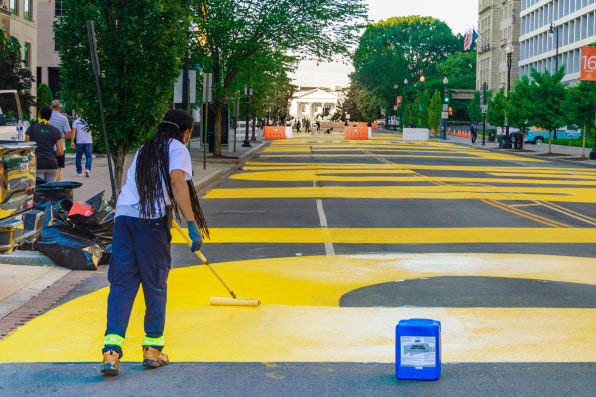
The project came to a forced landing by Friday. When Jones showed up in the middle of the night, the city's Department of Public Works (DPW) had street sweepers clear away the rain, which had stopped around midnight.
It was slow. As Jones tells the story, they only had four gallons of yellow paint, and it took three hours to measure the first “B” for Black Lives Matter. The paint ran out before the “L” was ready. Around 7 a.m., DPW showed up with more yellow paint, but it was a slightly different shade of yellow, so the team had to repaint the B and L before moving on. Worried that they would still run out of paint, they diluted the cans as they went along.
Spectators asked what the team was doing. At first, they weren't sure if they could say. Eventually, they admitted it was an order from the mayor's office. Citizens began asking if they could help, and so the DPW staff found more paintbrushes and took off their uniforms to paint as well. The original art team took on the role of supervisor to manage the volunteer team. "This wasn't planned, but it was very exciting to see," says Falcicchio.
Jones echoed the sentiment. “I think the universe just opened up,” she says. “I did some protests, I did the Million Man March when it came back. I’ve been in a lot of spaces and the energy felt so different.”
Local news broke. Then national news broke. The mayor arrived for a press conference. “And that’s when we realized she was renaming the entire square,” says Jones. “That’s when we were like, whoa, this is really, really, really big.”
The following day, Black Lives Matter DC adjusted the mural, erasing stars that had been included on the DC flag and adding "defund the police".
The Modern History of Murals
Murals have been a tool of persuasion. The modern mural as we know it is rooted in what was once considered radical, left-wing politics.
The media traces the history back to the Mexican painter Diego Rivera, who revitalized murals in the early 20th century. As Robert W. Cherny, professor emeritus of history at San Francisco State University, explains, Rivera learned mural making by studying the art of the old Renaissance masters in Europe. They made murals more than just painting on the wall. They used a technique called fresco, which requires a layer of wet plaster on a surface, which you paint over while the plaster dries. The technique melts the image into the surface of a building, transforming it into a piece of the urban landscape.
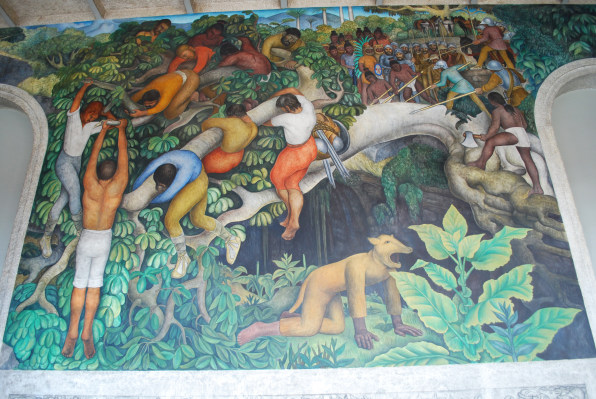
Rivera and his contemporaries, such as José Clemente Orozco and David Alfaro Siqueiros, were leftists and used the medium to re-enact Mexican history. In the Palace of Cortés, a palace built by the Spanish conquistadors in 1523 after claiming the land from the Aztec empire, he painted one of his most striking works. Commissioned by the US ambassador to Mexico, the piece depicted the history of Mexico since the Spanish invasion – portraying how the conquistador Hernán Cortés encountered the local inhabitants, started a war, and enslaved Mexicans to manage plantations and even to build the very palace where the work was displayed. The mural ends with the Mexican Revolution, as the revolutionary leader Emiliano Zapata walks alongside a white horse taken from the conquistadors. “That’s where Rivera found his great subject,
American artists began copying Rivera's work. As part of the New Deal in the 1930s, the government hired artists to paint murals on public buildings across America. But while Rivera had worked without censorship, New Deal murals couldn't be overtly political. Instead, they tended to depict positive aspects of capitalism and the expansion of the West (notably erasing Native Americans in the process). A frequent motif was the NRA's blue eagle, the New Deal's most recognizable symbol. “The artists liked the fact that the federal government was giving them work, obviously, and sometimes subtly, and sometimes not so subtly, they were promoting the New Deal,” says Cherny.
World War II brought the U.S. out of the Great Depression and the New Deal ended. But murals remained an American art form, fostered by local communities, especially Latino and Black artists, throughout the 20th century. Today, many large cities, like DC, provide a budget for murals.
The communities demanded murals for themselves.
At their core, murals can help communities create meaningful public spaces. In the early 1900s, Mexican immigrants began moving into a community in San Diego called Logan Heights – many of them fleeing the Mexican Revolution. In the 1950s, the government divided the residential area with industry, bringing factories and pollution. Then, in the 1960s, the city split the community in half with a road, destroying thousands of homes in the process.
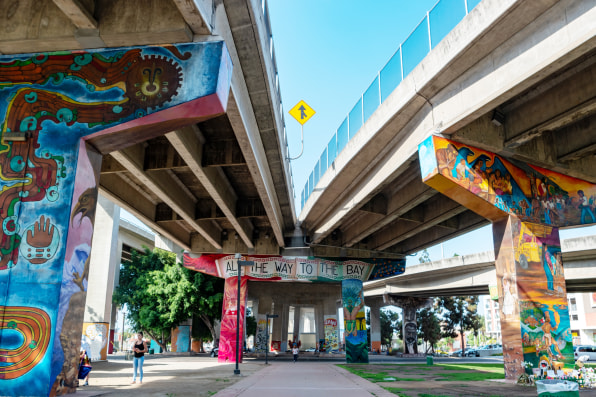
“In response, the community protested the placement of this highway interchange and, although they were unable to block the highway, they demanded the right to paint murals on the highways,” says Eric Avila, a professor and cultural historian at UCLA. These murals have become a historical landmark of the state, but more importantly, they created the structure for an 8-acre gathering space under the highway called Parque Chicano. “They created an almost sacred space where there are annual festivals and gatherings to celebrate historical moments in Mexican and Mexican-American history,” Avila continues. “There are car shows, community festivals. And it’s all housed within this infrastructure that has been covered in these murals by Chicano, Central American, and Indigenous artists as well.”
Ávila sees a parallel to the DC mural: "It's something very similar to what's happening in DC," Ávila concludes. "It's the reappropriation of public space in the name of inclusion, diversity, and equality.".
A similar story occurred in Bronzeville, Chicago, in 1967, when muralist William Walker spoke with the owner of a local TV and radio store, asking if he could paint a mural for the Black American Cultural Organization. What he created, alongside many volunteer artists who had never painted murals before, was the Wall of Respect , featuring portraits of inspiring Black figures, including Malcolm X, Muhammad Ali, and Harriet Tubman.
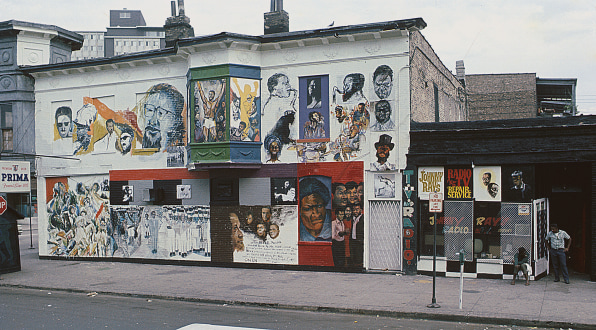
“On the South Side of Chicago in those days, you didn’t even see posters… with Black faces on them… it was a real intervention to put up a monument to Black heroes and heroines,” says Rebecca Zorach, professor of art and art history at Northwestern University. Wall of Respect It was more than a symbol. It became a meeting point for Civil Rights activists, an ad hoc community space where they gathered when visiting Chicago. Somehow, the building caught fire in the early 70s, so the city demolished it, along with the wall.
A persistent question about Black Lives Matter Plaza, for Zorach, seems to be whether it serves as a gathering place or represents a gentrification of the Black Lives Matter movement. She points out that Chicago itself has been criticized for the past 10 to 15 years, as the city hired street artists to decorate the rapidly gentrifying Mexican community of Pilsen in the South. “There’s a sense to it… it’s a sign of appropriation of what was a more grassroots movement to create an image that attracts white suburbanites to live in a neighborhood,” says Zorach.
A mural in DC is different.
The Black Lives Matter mural in DC is unique from these historical precedents in a significant way: its identity is inherently complicated by the fact that it was painted in our nation's capital, a capital that is largely democratic and features an increasingly smaller majority of... 46.4% of Black and African-American people living among Republican federal government employees.
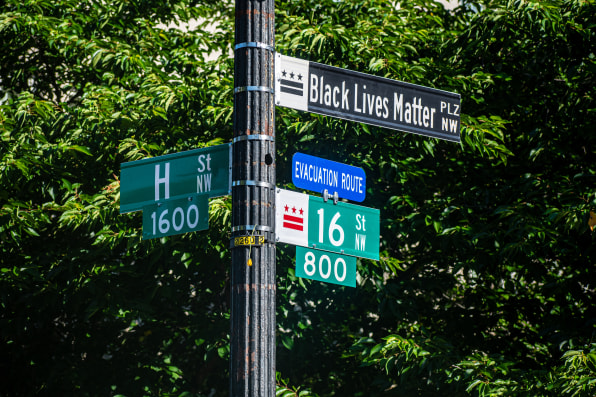
“DC is unlike anywhere else in the U.S., politically,” explains Ceasar McDowell, special consultant at the MIT Media Lab and professor of civic design practice. “So, you can look at it and say that this is really a government institution that, by itself, is struggling, as are the people who live in it, who are mostly Black, and this is a way of expressing and acknowledging their own struggle. It’s very different from other cities like Atlanta or Detroit. DC is… a place where the president can call in the National Guard and the mayor of DC can’t do anything about it.”
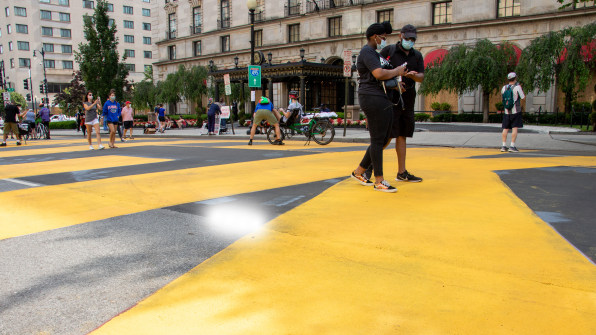
This makes the CD mural more vulnerable to criticism (how effective can a mural really be when it responds to the commander-in-chief along the way) and more radical than other similar efforts. “In this country, we have a powerful language of criticism,” says McDowell. “We know how to talk about what’s wrong with something, how to look at it and take it apart. What we don’t have a language for is transition, and in the transition space it’s really difficult… You have the job of undoing what should contribute to undoing it.”
BLACK LIVES MATTER IS A MOVEMENT IN RAPID TRANSITION
In the two weeks since Bowser commissioned the DC mural, similar Black Lives Matter street murals have sprung up across the United States. Jones, as the only artist to break anonymity on the DC project, has received emails from protesters explaining that they are attempting to mount similar murals in their own cities.
They are also facing criticism. Here is a Twitter user's response to Flint, Michigan, painting a mural on Martin Luther King Ave:
Downtown Flint, Michigan. #BlackLivesMatter pic.twitter.com/vPLmfC4n2p
— Eric Woodyard (@E_Woodyard) June 14, 2020
This tweet, which has been liked over 200,000 times, shows why art seems distracting at best – and dangerous at worst – amidst rampant inequality and injustice. Why include resources in a symbol when there are so many systemic problems that need fixing and so few resources available?
Eeshyia King, a Flint resident and one of the volunteers who helped paint the mural featuring the Black Lives Matter Flint chapter, defended the artwork. “I think it’s a really big statement in Flint just because the whole foundation of the Black Lives Matter movement starts with the system,” she says. “And in a place like Flint, all of our problems have come directly from our government.”
King, alongside DeWaun E. Robinson, a chapter leader of BLM Flint, insists that this was not a city government photo. It was a community-funded project, created with volunteer work. The team obtained city approval beforehand, and if they hadn't? The mural likely would have been painted anyway. “The Black Lives Matter movement goes hand in hand with the water crisis,” she says.


