
The four design jobs created by AI (so far)
What does "AI Design" mean?
When someone says "AI design," everyone in the room imagines something different.
One person is considering using AI to generate component variations for a design system. Another is designing a chat interface. A third is structuring data so that an AI agent can analyze it. A fourth is defining the behavior of an LLM (Leadership in Machine Learning).
They all fall under the category of "AI design," but they are not the same job.
I see this in job postings, LinkedIn posts, and conference presentations. Someone says, “We need to define our AI design strategy,” and everyone at the table agrees—imagining something completely different. Six months later, everyone is frustrated because the “AI design initiative” wasn’t what they expected.
The discussion about AI and design is branching out. What was once a single (admittedly vague) topic has split into at least four distinct orientations. Each focuses on a different type of design work, fits into different organizational structures, and uses different definitions of what is considered "good." Most teams are composed of professionals focused on only one of these orientations, confused about which one they are following or trying to move between them all without realizing it.
Then, Which of the four AI design orientations do you fit into?
The Engine and the Car
An AI model is an engine. A powerful and complex piece of technology that works internally. You can buy just the engine (companies like Anthropic and OpenAI sell directly to developers through their APIs). But most people never experience AI that way.
Most people experience AI inside a "car": the dashboard, the steering wheel, the seatbelt—all the parts that transform raw capability into something a person can actually drive. Most people don't care about how the engine works. They care that it gets them where they need to go.
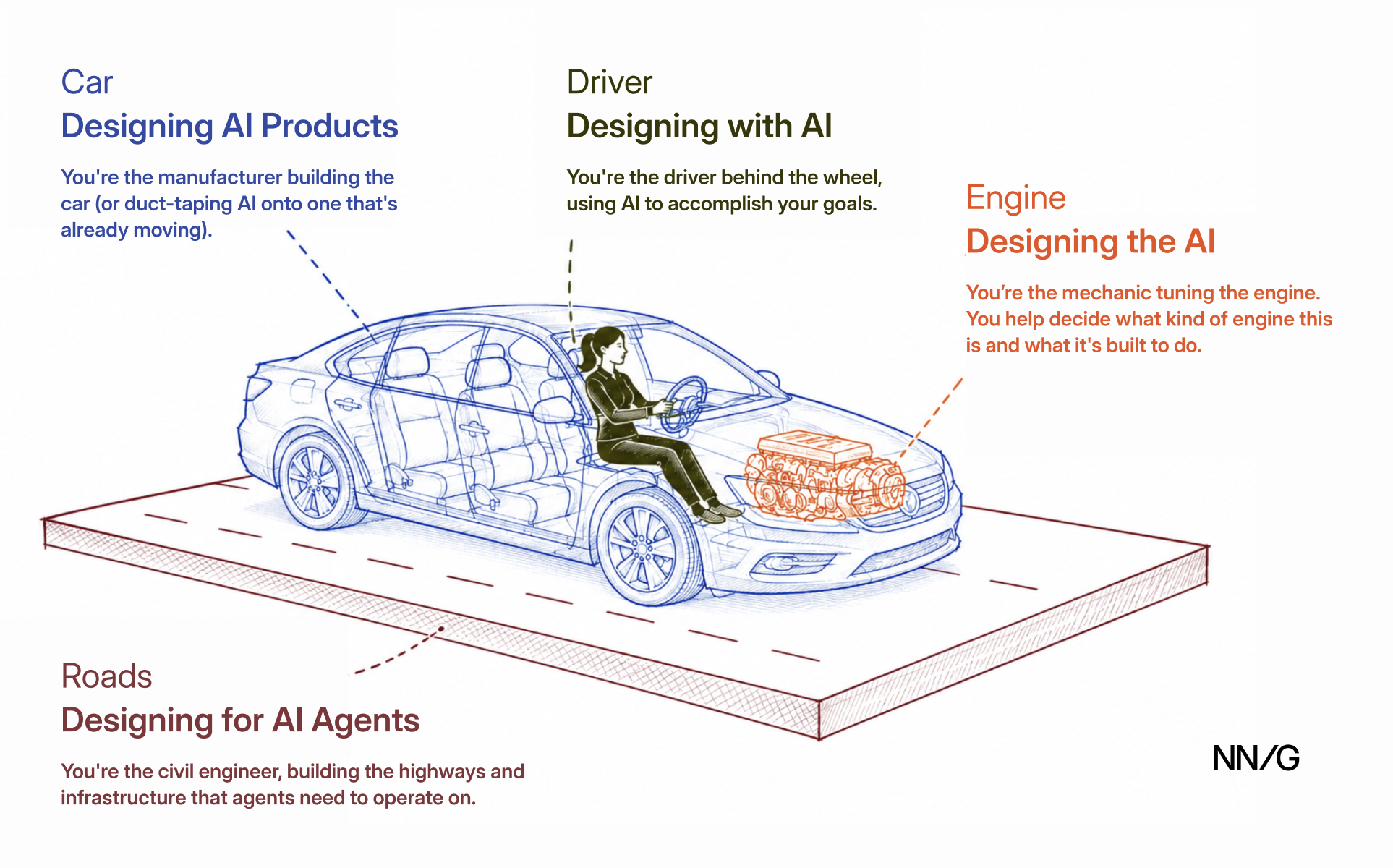
This metaphor leads us to four different meanings of "AI design." Each of these meanings implies a different type of work, skills, questions, and success metrics. They are not mutually exclusive, but they are very different.
The four meanings of "AI design"“
Laura Costantino He sketched an initial version of this structure in a post on LinkedIn . I developed it in a different direction, reshaping one of the categories and expanding the others.
1. Designing with AI
You are the driver. You are driving.
This is the approach most people initially consider. Do you use AI in your design process? to idealize , to create prototypes , to generate texts , build inspiration boards , to carry out research/ competitive analysis or critically evaluate Your own work. AI tools are your vehicles, and you use them to go further, faster.
This is where most designers find themselves today, and there's nothing wrong with that. AI as a tool is transforming the way design work is done. Entire workflow steps that used to take hours now happen in minutes.
The trap lies in treating this type of work as if it were all there is to “AI-powered design.” Leadership says, “We’re incorporating AI into our design practice,” but what they really mean is, “Our designers are now using Claude Code.” While this type of AI-powered design is a start, it ignores all the other ways AI is reshaping design opportunities within the organization.
2. Designing AI Products
You are the manufacturer. You are building the car (or adapting artificial intelligence to one that is already in motion).
This is where you design the product or interface that offers AI capabilities to users: the dashboard, the steering wheel, and the seatbelt. Everything that transforms a powerful engine into something people can drive without understanding combustion.
This type of work can be delivered in two ways:
- AI-native products These are the ones in which the entire product é The AI experience: Claude, Perplexity, Cursor, ChatGPT, or Midjourney. You're designing the car from scratch. There's no existing product to integrate. Every design decision shapes how someone experiences the AI capability itself.
- AI capabilities in existing products These represent a different design challenge: Notion's AI, intelligent composition in Gmail, or an AI summarizer in your meeting tool. You're adding a new component to a car that's already on the road—a car with already established standards, navigation, and user expectations. The AI needs to fit into something.
These types of work involve different design challenges with different obstacles. For AI-native products, the difficulty lies in the absence of mental models established frameworks to build upon: you are teaching the user new paradigms. For AI features in existing products, the challenge is to connect the AI feature to the rest of the experience in a natural and meaningful way, even if no one has requested it.
3. Designing for AI Agents
You are the civil engineer. You design the highways and create the necessary infrastructure so that the agents can operate.
This new feature will seem like a radical change to the user experience. Stay with me.
In this type of work, you create content, data, or interactions that AI (non-human) agents will read, analyze, or use. You are building the infrastructure that autonomous systems use to navigate. If the AI agents are self-driving cars, you are designing the roads, signage, and lanes. AI agents are its users.
This could mean structuring product data so that a purchasing agent can compare options on behalf of the user, writing instructions that an AI assistant will follow, or optimizing content for AI search and discovery instead of (or in addition to) human search and discovery.
Some of this infrastructure won't even be readable by humans. A sign designed for AI-controlled vehicles can encode information in ways that no human driver could decipher—data transmitted via radio or embedded in non-visible parts of the electromagnetic spectrum. The "user" of this sign is an agent, and the design constraints are completely different.
This is the guidance that most design teams still ignore, mainly because many organizations don't have anyone explicitly responsible for how AI agents interact with their products. This means that either it's not happening, or it's happening by chance within an engineering team without any input from the design area.
Designing for AI agents is important because it involves design decisions. What data is exposed? How is it structured? What can an agent do, and what requires human confirmation? These factors shape the end-user experience as much as any interface; they're just one layer below.
4. Designing AI
You are the mechanic. You're tuning the engine. You're helping to decide what kind of engine it is and what it's designed for.
In this type of work, you help shape the model: its behavior, its evaluation criteria, and its principles. You work together with engineers to define what the AI does, how it responds, and where it draws the line.
For example, you can define evaluation criteria to test whether the model outputs meet quality standards, collaborate with engineers on fine-tuning the data, or build the principles that guide adversarial testing—what the model should reject, where it should express uncertainty, and how it should weight conflicting instructions.
Until now, the industry has treated these activities as purely engineering work, but they are not. They involve design decisions. Designers are not the only ones who can make these decisions (an ethics specialist, a copywriter, or a psychologist can also contribute), but designers are trained to integrate them into a coherent experience and test them against user needs. We are starting to see job postings that recognize this competence.
Current Situation of the Field
These four types of “AI design” work are not mutually exclusive. A single designer might work on two or three of them in a month. Not every organization needs all four. A company using an off-the-shelf machine learning platform (LLM) via an API might only need the first two (AI design and AI product design). The third and fourth orientations become relevant as the organization’s relationship with AI becomes more complex—for example, when developing agent-facing infrastructure or an in-house machine learning platform.
What differentiates them is that each involves designing for a fundamentally different type of behavior — human behavior with tools, human behavior with AI interfaces, agent behavior within the infrastructure, and the behavior of the model itself. Different behaviors require different types of specialized knowledge.
My point isn't that you should choose just one path. It's that each path develops a different kind of specialization, and that specialization deepens over time. For example, the more time you dedicate to AI product design, the better you become at that job.
Understanding which type of AI design you're developing expertise in is important because the market is constantly evolving. Currently, few designers have in-depth experience in multiple areas. However, this opportunity won't last long. Within a year, many more designers will have significant AI experience. Those who specialize in a specific area now will have a considerable advantage over those who remain with a broad, "AI-adjacent" view.
Here is the current situation:
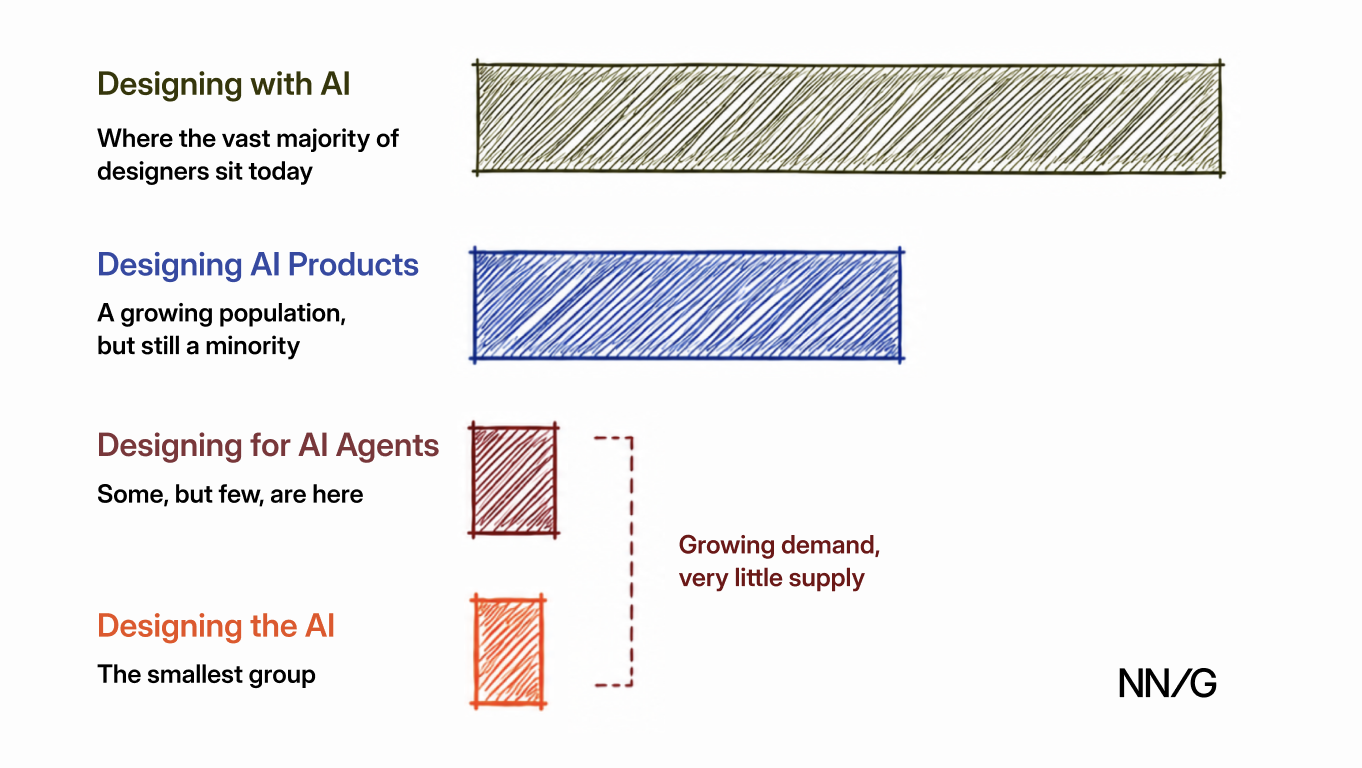
Today, most designers use AI as a tool in their workflow. A growing number of them are designing AI products and features. Very few, however, design for AI agents or AI itself.
The demand for these last two professionals is growing. The supply of designers who master them is practically nonexistent. Therefore, if you are a designer, this opportunity gap is widening.
As agents become more common, someone needs to design how they interact with products, content, and data. As models are incorporated into more experiences, someone needs to define how they behave. Currently, that person is usually an engineer who makes those decisions by default, when it could (and I would argue should) be a designer.
What changes when you understand all four?
Understanding that our field of work is branching out when it comes to AI changes the way you work, whether you're an individual contributor, a leader, or a hiring manager.
If you are a freelance designer, You can stop vaguely being an “AI designer” on LinkedIn and start naming what you actually do. The skills for designing with AI (understanding instructions and workflow integration) are different from the skills for designing AI (evaluating models, defining principles, and collaborating with machine learning engineers). Identifying the type of work you do can indicate which skills are important for your future development. Knowing which area you work in do you want Acting will tell you where to invest.
If you are a design leader, You can audit your team against the four types of work and understand where gaps exist and whether it makes sense to fill them. Most teams already use AI in their workflow and may have partial coverage for AI-based feature design. Fewer teams have clear coverage for agent-facing infrastructure design or AI system behavior—and that may be acceptable, depending on how your organization develops with AI.
If you are hiring, You can stop writing generic job descriptions for "AI designers." Name the specific job, hire based on specific skills, and evaluate based on a specific definition of good work.
AI has reshaped the field of design and created four new perspectives through which you can view the world. Your first step should be to identify which one you want to pursue.


