

Coding agents do not have a competitive advantage.
The last few months have been difficult for Anthropic.
It started well. According to them, the new model was so powerful that there were concerns about launching it due to its vulnerability to hacker attacks.
This narrative was marred by several egregious errors. First, they leaked all the source code of Claude Code . Then, some users succeeded. Access Mythos in advance by successfully guessing the API URL. . These weren't sophisticated attacks, and that raises the question: if Mythos is so powerful at finding vulnerabilities in software, why couldn't Anthropic avoid such simple mistakes?
Isolated errors generated negative reactions from users. Anthropic banned the use of OpenClaw , but then He reversed course on that policy. . Complaints about the strict requisition limits are becoming more frequent, and with them come questions about Anthropic's ability to meet the demand. Amidst this, they They conducted a bizarre A/B test in which 2% of the new subscribers to the basic plan were denied access to the Claude Code. .
Removing Claude Code from the basic plan is a change. drastic In the company's policy, it's not just a tweak to the homepage's appearance. Certainly, new users unlucky enough to be denied access to Claude Code will react with confusion and anger, given the service's high visibility.
The answer Anthropic sought to reassure users, guaranteeing that plan subscribers... basic They would not lose access to the Claude Code., at least for now . This was met with understandable skepticism.
Fortunately, the cost of switching coding agents is zero.
None of these incidents affected me. annoyed , However, I've been increasingly affected by Claude Code's rate limits. In response, I migrated most of my work to Codex. It's amazing how little I needed to change my workflow. I lost some conveniences, like starting a coding agent session from my mobile phone, but overall, it only took a little... minor inconvenience so that I could switch providers without having to adjust how I used the tools.
OpenAI appears to have been the first to recognize the problem of a lack of competitive advantage, as evidenced by efforts to derail the use of the Chat Add-ons interoperable API. First, there was the Assistant API , which transferred the responsibility for storing chat messages to OpenAI, instead of to the user. When that didn't work, they announced the Response API . Neither of them seems to have gained much traction.
Anthropic sought to make Claude more unique by offering more workflow enhancement features, such as Coworking . However, these features do not represent a true competitive advantage: the user still retains ownership of the code and data. Workflow-facilitating features can be quickly replicated by both commercial competitors and open-source projects—it's worth noting that Claude Code itself functions very similarly to an active open-source project that preceded it., Aider .
These tools are, ultimately, code editors, a software category that has always faced strong competition in the open-source market. Commercial vendors like Eclipse and JetBrains profited from selling professional licenses, but they did so by adding sophisticated tools for advanced users. The nature of code agents undermines this strategy, since all their added value lies in eliminating the need for a complex interface. All you need to do is tell the agent what you want the program to do, in simple language!
How to prepare for the future
If you're still concerned about being reliant on a single LLM provider, I believe the best way to protect yourself against that is... optimize for humans .
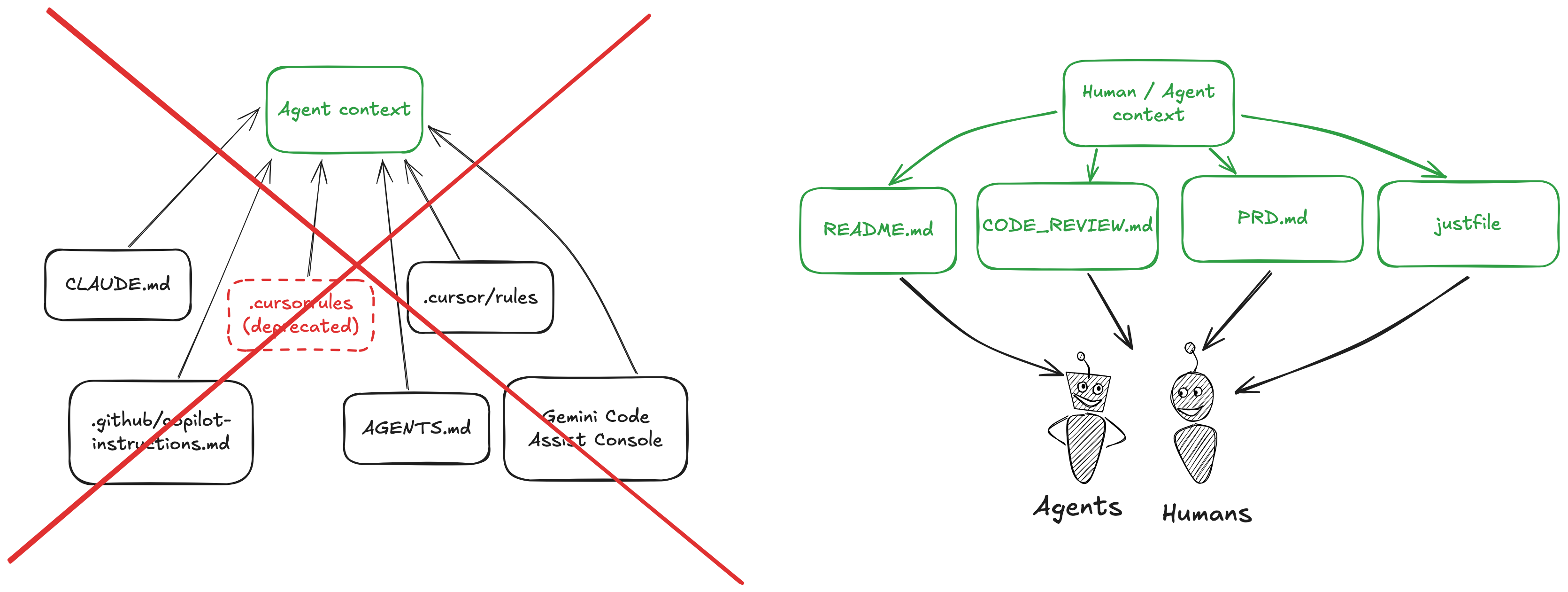
If an agent can execute a script or access a document, organize your repositories in a way that humans can also do so easily. I believe this strategy is the most efficient way for humans to leverage agents: the agent should adapt to the human, not the other way around. This also ensures future compatibility: if a human can access your LLM-focused scripts and documentation, it will likely be very easy to integrate a new programming agent.


