
What is a mental model and how does it relate to user experience?
Mental models: one of the most important concepts in human-computer interaction. .
When you interact with a website or an app, do you think about how to interact with it – swiping, scrolling, or anything else – or do you just do it without much thought? Well, if you think about the first option, that means you have a mental model of how digital user interfaces work.
The concept of mental models comes from the Scottish psychologist Kenneth Craik, in his book "The Nature of Explanation". He stated that the mind constructs "small-scale models of reality" to anticipate events.
What are mental models?
Mental models are how we think and what we expect about how things work in the real world. They influence how we behave, perform tasks, and solve problems. They also help us decide what to do.
A mental model is based on belief, not facts: that is, it's a model of what users know (or think they know) about a system like your website. – Nielsen Norman Group
They arise from the way human beings perceive the world around them and are developed from observation, perception, immersive experience and, most importantly, culture.
These models are not based on facts, but on a person's past experiences and what they think they know about a system. So, basically, since these beliefs are based on cognition, the Users will bring the expectations they've formed around a familiar product to another product that appears to be similar.
Think about how young children interact with a touchscreen today. Since they were born into the technology age, many of them have spent more time interacting with touchscreens than with books. And when they do see a book, they are surprised when the passage doesn't work. Their brains have stored a mental model for an action, and they replicate it in other situations.
Another example is how you store documents on your computer. Whether you're a more organized person or not, it's the same way we used to store documents in an older filing system.
How does this relate to user experience?
Mental models give designers a path when designing digital interfaces. They provide designers with a way to explore how they create interfaces to communicate their functions through their form.
In other words, if you can understand your users' mental models, you can replicate them in your designs to make them more usable and intuitive.
Jacob's Law
Jacob's Law states that:
Users spend most of their time on websites other than yours. This means users prefer your website to function the same way as all the other websites they already know. Design for patterns that users are accustomed to.
A good rule of thumb is: your users are people. And people expect websites to act the same way.
Thus, a large part of Customers' mental models from your website will be influenced by information collected from other websites. .In summary, they expect the functionality to be consistent with these previous experiences, and wherever a user interface pattern exists, it should be mirrored in their interfaces.
Gestalt Principles
Another good way to understand how people structure and perceive their surrounding environment is to have a clear understanding of Gestalt Principles.
Understanding how the brain works will certainly help you become a better designer.
The implementation of principles from the Gestalt Studying theory, patterns, and guidelines can greatly improve not only the aesthetics of a design, but also its functionality and ease of use, and they are a valuable set of ideas for any designer to learn.
Mental models and cultural context
Our mental models are influenced by our countries, families, neighborhoods, experiences, backgrounds, and cultures. All of these variables condition how we behave and perceive the world.
For example, people in the Middle East write from right to left, while people in the West write from left to right.
Take a look at the Facebook homepage in two different cultures. The image on the left is a Middle Eastern version and the image on the right is the US version.
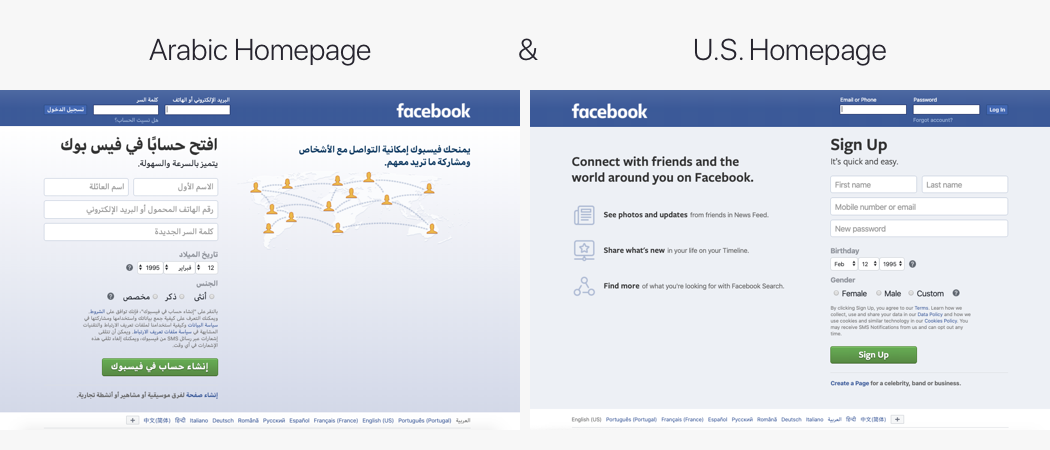
As designers, or anyone developing a human experience – whether digital or not – we need to understand this in order to create a usable website.
Mental models and innovation
Design and innovation have always been a good match. Therefore, applying mental models to our work as designers is an excellent foundation for maximizing usability.
Designing and creating with existing mental models can also be great for bringing innovation to the table. This can mean Improving existing products simply by aligning them with user expectations.
Leveraging existing mental models does not mean that designers should avoid innovative design solutions. Human beings are capable of evolving and expanding mental models. However, changing our mental models must be done strategically. Because when a user encounters a product or experience that challenges their mental models, they may become frustrated and give up.

A good example of a mental model applied with a touch is Apple's Face ID recognition. People were already used to and comfortable using doors with fingerprint locks, but when Apple launched Face ID recognition, the initial reaction was skepticism.
Now that you know what mental models are and their value in the design process, you may want to learn more and take the next steps.
There's a great book I recommend that contains 30 thinking tools for better decision-making and problem-solving:
There are thousands of mental models, but the best ones can be widely applied to life and are useful in a wide range of situations.
Understanding these models helps to better understand their users and to simplify, make decisions, and design better solutions.


