

Thief of the Future – Speculative Design Methods and Tools
Combining science fiction world-building techniques with design to uncover unseen potential futures.
Designing for tomorrow is like having a time machine that takes you to alternative futures. You'll be tempted to visit Utopias, but only one Thief of the Future A dedicated visitor will explore the dystopias from which we must steal to prevent products infested with dark tendencies from bringing about the end of the world.
The path of a artifact killer It's not easy, though – you'll have to take apart something that a fellow designer might create in the near future, or perhaps it is. Something created by your older self!
If you dare to tread this dangerous and exciting path, let me introduce you to the mind-blowing practice of... speculative design – to steal a dystopian artifact from a future that may never exist in order to prevent it from soothing the world tomorrow.
There's a dangerous paradox there, but let's move on.
This two-part series This summarizes what speculative design is and how it can be practiced. If you missed Future Thieving #1, “ Stealing from the future with speculative design. ”, Here he is. .
Welcome to the future!
Assuming that you now have a good idea of what é speculative design , you will need to learn stealing an artifact from the future. To continue your training as Thief of the Future , I have gathered here for you complete methods and individual tools from across the web.
Speculative drawing methods
There are many variations of application to be used, depending of the objective Regarding the project – are you exploring future business opportunities, generating discussions on a specific topic, or creating fiction or art? Seriousness The outcome is also important – are you just playing around with ideas or are you planning a company's next product line?
A speculative drawing method
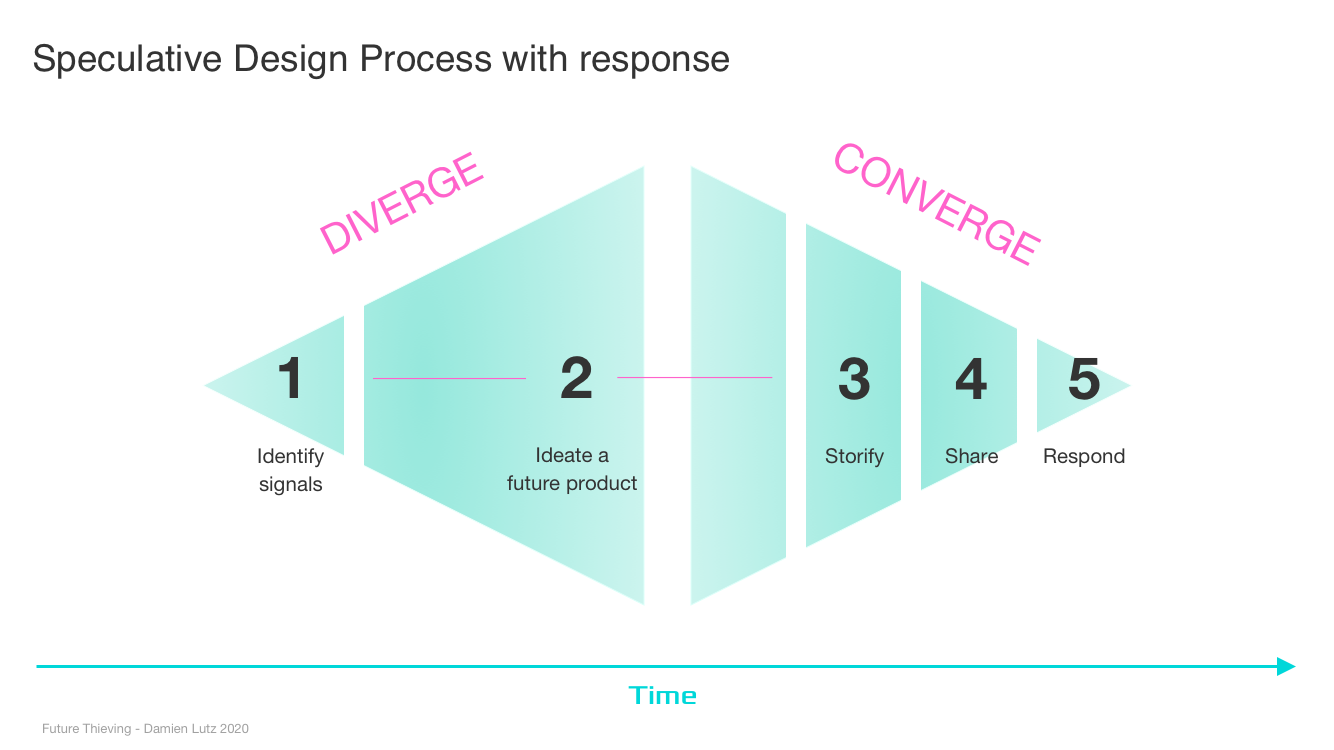
Used on its own, a speculative design process begins in the future and 'launches' the experiment back into the present.
- Step 1 – Identify 'signs' of emerging technologies and trends
Since speculative design deals with less anticipated futures, the process begins with identifying additional technologies and cultural trends. Look for these 'weak signals' in emerging technologies and experimental uses. - Step 2 – Create a future product
Based on Step 1, use various speculative design tools to create your future product (see Speculative design tools below). - Step 4 – Store the product
Design a diegetic artifact that can solve a problem in your future world. Ensure that the artifact's form and function are consistent. Tell a story about your future world. and inspire the audience's imagination to fill in the gaps. These personal interpretations imbue the discussion in the next step with energy and personality. - Step 5 – Share to generate discussion
Whoever your target audience may be – stakeholders, fellow designers, social media followers, or the general public – make it easy to offer an interpretation of your product. Be prepared with questions that they will ask. encourage articulation Why they like or dislike their future concept, how it might affect them personally, and what they prefer.
Although speculative design generally doesn't include follow-up actions, I suggest we consider adding a response from the prototype creator as an essential final step. While the discussion stage is thought-provoking, it cannot guarantee changes or effects on the audience, or action from them. Apathy strengthens dominant forces, but speculative design began as a challenge to ward off the powerful current of mass consumerism that has blindly swept over us.
One commitment to action The creators' response to any newly realized perspective can be as simple as:
- Organizing a ideation session with fellow designers
- Request expert feedback – such as scientists and engineers – or potential users of the future product.
- Learning to contribute to a problem identified in the process , How to join a related group or write to a PM?
- Be creative and use a method of future installation of the guerrilla , How to create a promotional website for our future product – just be sure to track and record comments and reactions.
To inspire this step, read about the beautiful concept of active hope (not an affiliate link), which goes from passively wishing for a preferred future to actively manifesting it, with a focus on sustainability.
Including a final response stage and based on the diamond design approach, a simplified speculative design method It could be like this:
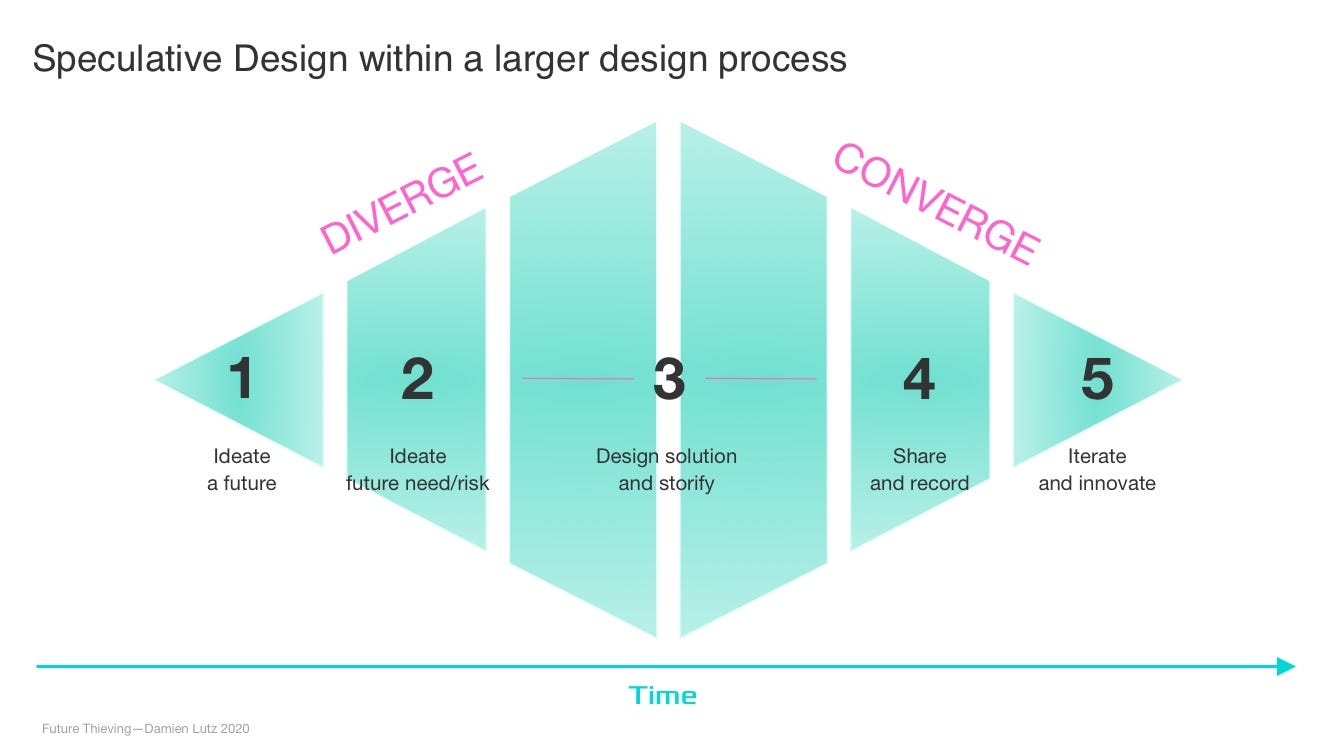
Speculative design as part of a larger problem-solving project.
Speculative design methods and tools can also be used as part of a larger, more serious design project, such as a company's future product line. An example of this process might consist of the following steps:
Step 1 – Create a future
Choose a time period.
If you want to innovate for a company, the title method Frog Design suggests launching 5 to 15 years ahead , ...depending on the sector. For an industry that updates its product line every 3 years, it makes sense to project at least 3 years into the future, and projecting 9 years ahead would be similar to looking 3 cycles ahead. For slower-growing industries and leading companies in their industry, looking even further into the future can help with long-term strategy and detecting new threats .However, the further into the future you envision, the more blurred the landscape becomes and the less viable the potential cast of characters appears.
Ask "What if?"“
Think in terms of areas of potential growth, risks, existing related technologies, emerging and proposed new technologies, competitors, user needs, behavioral trends, supply chains, and related industries. Search These areas should be mapped out, identifying where they might be located during the chosen period and how they might affect each other. Explore the best and worst-case scenarios .
Step 2 – Create future needs and problems
Ideas from users who inhabit the future, where you intend to identify their needs and explore future business problems to be solved.
Step 3 – Design a solution and store it.
Step 4 – Share and record
Step 5 – Iterate and innovate
Summarize the answers and findings and repeat the new versions to initiate a subsequent product innovation process.
Examples of speculative design methods
Cover story
Cover Story It's a game of imagination for companies to debate their ultimate future state., creating a magazine cover announcing its success. Players are asked to disregard existing limitations in order to view a “ best scenario for your company ”"And design the magazine cover in terms of title, quotes, images, etc. The process can reveal previously unimaginable ideas and directions for the company to explore.".
Based on The Cover Story Vision ® Canvas, Created by David Sibbet of Grove International.
The thing of the future
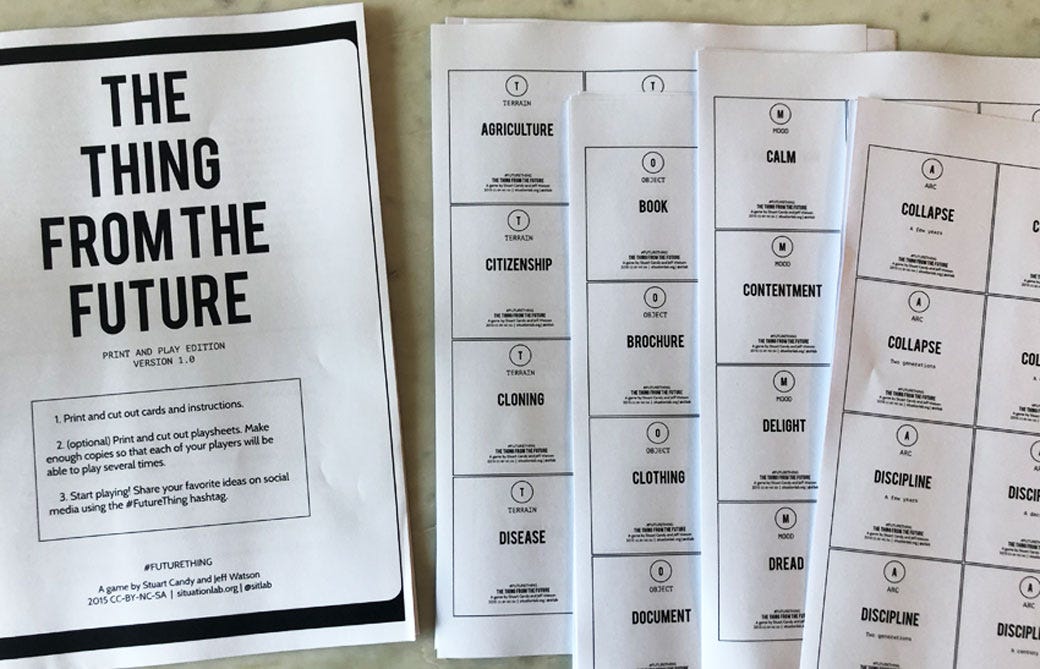
The Thing From The Future it is a award-winning card game for individuals or teams that challenges players to articulate objects of alternative futures .The deck consists of 108 cards in four suits – the type of future from which the object comes, its thematic context, its basic form, and the emotion the object generates in someone in the present.
Players take turns placing cards on the table until they have one card of each suit – this forms the players' creative prompt. Players then vote on which concept is... the best, the funniest, the most ironic etc. The winner of each round keeps the cards played, and whoever has the most cards when the game ends is the winner. The many speculative projects produced can be used for further exploration and innovation. Download the printable version here.
Created by Stuart Candy , professor of strategic foresight and innovation at the Ontario College of Art and Design (OCAD U), and Jeff Watson , assistant professor of interactive media and games at the School of Cinematic Arts, University of Southern California.
Frog Design's 'headline' method
A Frog Design uses your main method to help companies envision a future 5 to 15 years from now and the products and services that may be needed. Their process focuses on creating headlines for future news stories :
- Step 1: set the deadline
- Step 2: Research potential future risks to the business.
- Step 3: Create a future world
- Step 4: Create many hypothetical headlines for the imagined future.
- Step 5: Choose the key titles and workshop on how the company can solve these problems.
Future Ethnographic Experiments
Created by a forecasting practitioner and educator. Stuart Candy , and by the researcher / futurist Kelly Kornet , the Ethnographic Experiential Futures It combines ethnographic research into the future – a recording and the surface of existing concepts of the future – with experimental futures – a future ideation method that uses multimedia, multisensory, and other storytelling techniques – to create new future concepts , focusing on stimulating the senses. This wonderful approach makes speculative design prototypes a more impactful and relatable experience for the discussion phase.
Candy and Kornett suggest the following process:
- Map Research how people currently imagine the future to reveal what is considered possible, likely, and/or preferred.
- Multiply : envision alternative scenarios that challenge the restrictions applied to the items above.
- Mediate Develop these concepts through tangible and interactive experiences.
- Assembly Share via exhibition, interactive workshop, installation‘ future of the guerrilla ‘or other means
- Map Record response and feedback.
Candy and Kornett also created a field guide for the process of Ethnographic Experiential Futures.
Science fiction prototyping
The futurist Brian David Johnson developed science fiction prototyping in 2010, in response to the commercial challenge of anticipate market needs by products after they have reached the end of their design and production cycle. Its main methodology involves the generation of a three-act story as a speculative design prototype to innovate in the areas of science, engineering, business and socio-politics.
- Act 1: Create a future Choose a technology to explore and create a future incarnation and its experience.
- Act 2: Scientific Turning Point and its Ramifications Introduce a catastrophe and describe its repercussions for the user.
- Act 3: The Human Turning Point Explore and articulate how a user would remedy their situation.
The story is then used for reflective discussions and further product innovation.
Speculative design tools
Designing for future scenarios is a highly creative and imaginative process; therefore, designers should feel comfortable drawing on the tools and techniques of design thinking and the creative arts – storyboards, interviews/questionnaires, games, role-playing, writing, animation, film, etc.
Here are some tools developed by others to help you design your future:
The Tarot Cards of Technology
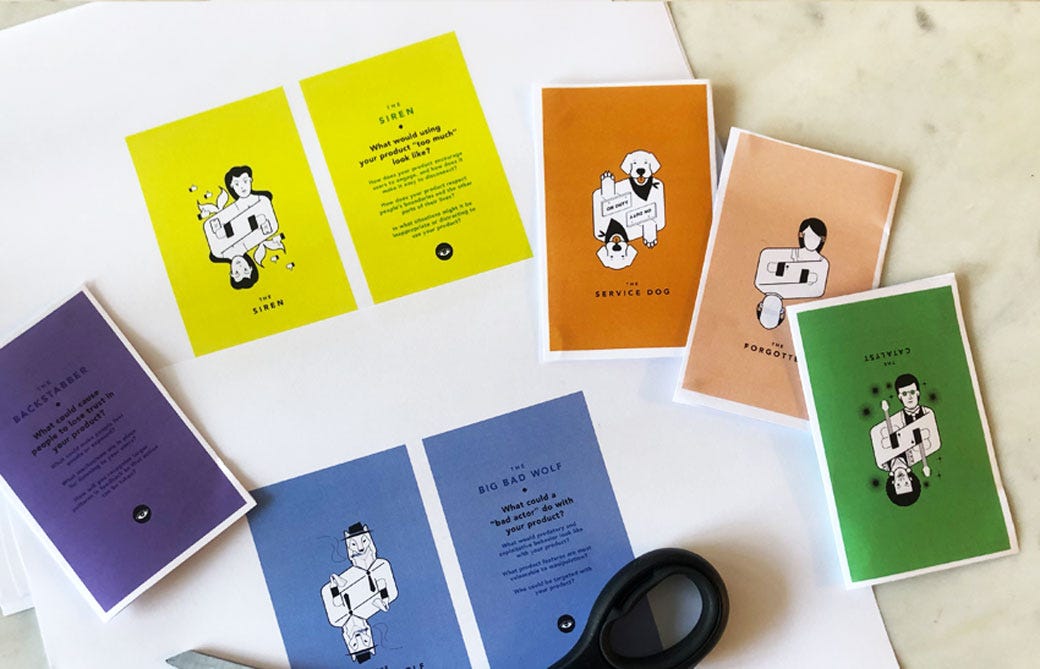
The Tarot Cards of Technology inspire product designers to predict alternative futures of their products or ideas .From the invisible and negative to the expected and ideal, the process helps creators slow down and consider more deeply. the impact of your product In addition to the obvious needs of its users.
Created by Artefact , a US strategy and design firm.
Future sweep
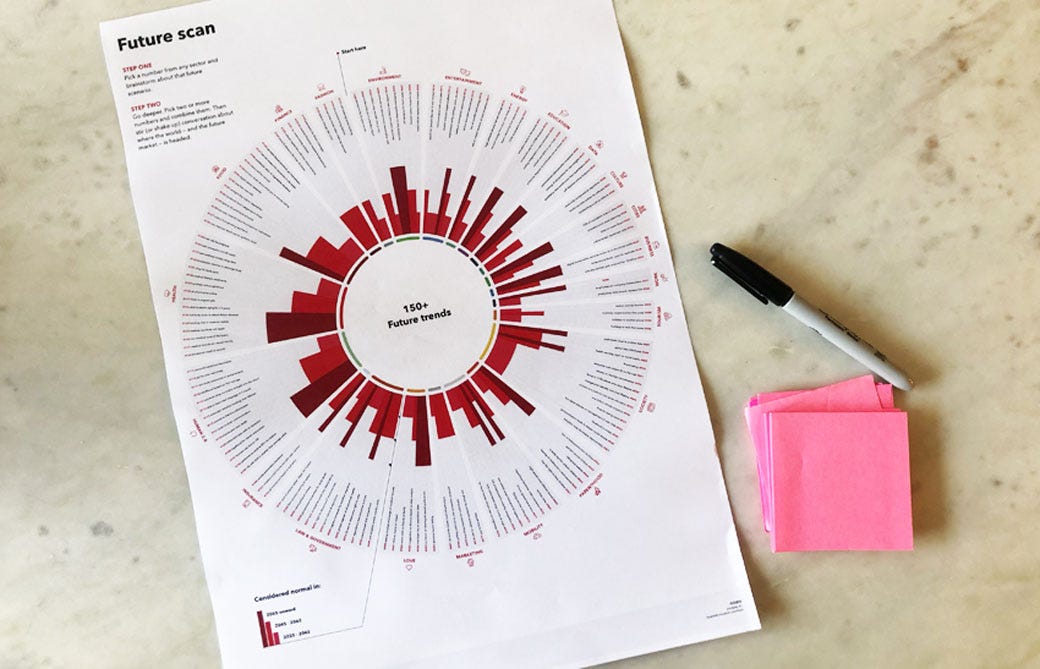
Another great tool for inspiring ideas is the beautiful map. Future Scan of Board of Innovation .It offers more than 150 potential future scenarios, Based on cutting-edge technologies and social changes, the map can be used as a simple exercise, choosing a number on the map and brainstorming that scenario, or as a tool in a larger speculative design process.
Trendy Cards
WeDesignThinking This is a group of design thinkers from the Netherlands who develop visual thinking tools, training, and workshops, and have created over 200 tools that they share freely. One of the tools they lend to future design is... Trend Cards , which are grouped into four themes:
- Innovation
- Economy
- People
- Regulation
Used in a mind mapping session in conjunction with your Trend model , Cards can help to map trends, create future scenarios, and explore ways to protect a product or strategy in the future.
Created by WeDesignThinking .
Future timeline
The line of future time It's a fascinating and resource-rich website that brings together forecasts for... the next two centuries and beyond , ...including data and technology trends, articles on emerging technologies, and much more. Created by the writer and futurist... William James Fox ,Based in London and regularly updated since 2008, The Future Timeline began as a small, quirky website featuring a brief list of future predictions. Insightful and provocative, the idea attracted many fans and contributors over the years, evolving into a vast project. community from futurology enthusiasts around the world.
You can use the Timeline of future as a resource for speculative design projects to generate ideas about the year or technology you are designing for.
Back to reality
If you're still reading this, you've earned a nomination to be a Thief of the future. So, let's talk about the biggest challenge you'll face when you return to the present with your grand and sophisticated ideas for the future – designing with values.
We, as designers, do our best to defend the user and us protect against dark patterns , ...but the consumer-oriented machine we designed is for fast, hungry movements. Its reactionary deadlines miss the proper validation of customer convenience, and Greedy budgets ruin the details. .
Therefore, if the voice you bring from Future Thieving If you get lost in the roar – like a fledgling canary in a coal mine tunnel – there's nothing wrong with acknowledging battles you can't win. immediately .But the machine's momentum cannot prevent it from traveling through a different tunnel, where other canaries may be. complaining about a design more aligned with value. Who knows, there might be a whole network down here.
This is one of my other tunnels, and here you are. Cheep Cheep.
This is the way
We need to talk about one more thing before a real Thief of the Future you become – the dangerous paradox of bringing something into the present day only to prevent it from existing tomorrow.
On one of your visits to the dystopia, you might be tempted to keep the advanced artifact for yourself and profit from the promise of its future seductive influence over the masses.
But the Thieves of the Future They have a code. – we promise honor the brave designers of the past sharing all the stolen rewards and encourage alignment of the lifestyles that our designs enable, along with our sincerely defined values.
This is the way .
Happy robbery, Thief of the Future , And don't forget to continue the story when you return to the present, in whatever way you can.
Our preferred future depends on it.


