
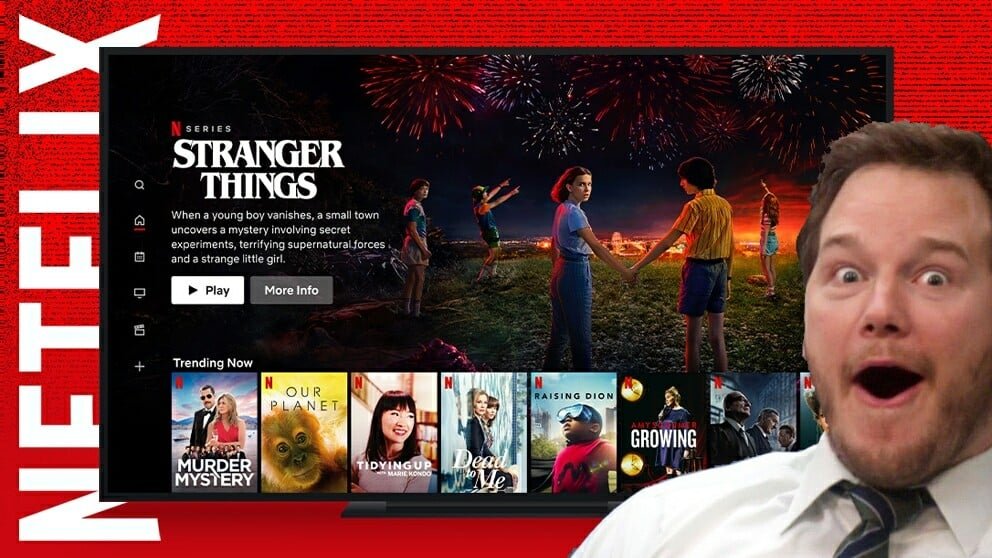
A masterclass in the psychology of pricing.
Adoption of Netflix's ad-supported subscription service was initially slow.
The Wall Street Journal reported that only 9% of new subscribers those who opted for this and, of those who they stayed Happy to see the ads, 43% had downgraded from more expensive options.
The result: Sign-ups in their ad tier doubled. .
This case study demonstrates a Pricing Psychology Masterclass and how simple changes (based on data and experimentation) can significantly alter the course of your product.
1. The Decoy Effect
It appears that Netflix has been successful in repositioning its comparative value proposition.
But let's consider another theoretical approach. What would happen if Netflix added a even more expensive plan .
For example: the super premium 'AI-powered' package, for 20x the price of the ad tier.

Intuitively, few people would pay £1,200 a year for Netflix. But that's the point.
There is a phenomenon called🦜 The Decoy Effect, where companies will offer an objectively inadequate package, with the sole intention of change your perception of the other options .
Most companies will never admit to using a marketing ploy.
But it has become a tactic to launch very expensive (and unnecessary) accessories., together with major product launches.
For example, consider the real value proposition of the following three Apple accessories:

To be clear; these products are real and probably very well built.
But I want you to examine the psychological benefit Subtle, happening far too often to be a coincidence.
They help to reshape the value of other products.
2. The Illusion of Work
There is a psychological bias called🏋️♀️ Labor illusion.
This applies to open-kitchen restaurants, where you can see the chef yelling at subordinates, coffee beans that you know were carefully roasted in small batches, and even server farms processing data with complicated algorithms (or AI) on our behalf.
During onboarding, Netflix will ask you to select at least 3 TV shows or movies you like, and then it will display this spinner:

Except that Netflix probably doesn't need a full 3 seconds to personalize your dashboard – it's likely generated instantly, especially considering how little it knows about you at that moment.
Instead, It's exhibitionism. , ...to give the impression that somewhere, a server is processing thousands of data points to personalize an experience.” "Just for you"” .
3. Cohort experimentation
Most people have experienced the paralysis of browsing through a vast film library, unable to make a decision.
There's a name for that: 😳 Hicks' Law.
In an attempt to loosen this mental constraint, Netflix created a feature that randomly selected something for you, called '‘ Surprise me ‘'.

Except it didn't work,” usage was very low. ”"and it has since been removed.".
That's because, simultaneously, they ran a very similar feature on the 'kids' version of Netflix, called '‘ Mystery Box ‘', that no It was removed.

I have a theory as to why this variant may have been more successful: It is the parents who make the decision. .
‘'Surprise Me' was a shortcut to finding something that you I had to watch it. You took the risk and the penalty of selecting something uninteresting.
But the 'Mystery Box' acknowledges that the father is usually the one who makes the decisions, and both may not care which episode of Blippy is selected, or even be in the room.
The important lesson here is not only that Netflix shows a willingness to experiment with solutions, but also that they have the discipline to remove them after they fail.
And even better; that they They tried a variety of solutions. , for specific audiences .
It's a useful way to rephrase an A/B test.
Did you conduct an experiment that failed completely? Or did you mistakenly try to measure the success of... all Your user base, rather than a specific niche that would truly derive value from the change?
Cheat sheet
👀
Things to read
1. UX Psychology for learning
💬
Conversations to have
1. Reconsider the experiments.
If you look back at your failed experiments, is there a possibility that they failed because they weren't targeted enough or were shown to the wrong audience?
Consider repeating the experiments or re-evaluating the data, but looking at specific user cohorts (e.g., age, device, gender, frequency of use, spending history, subscription duration, etc.).
2. product optionality
Can you test your prices/packages? Can you talk to real people about the perceived value of each option? Can you leverage psychology to reframe this?


