
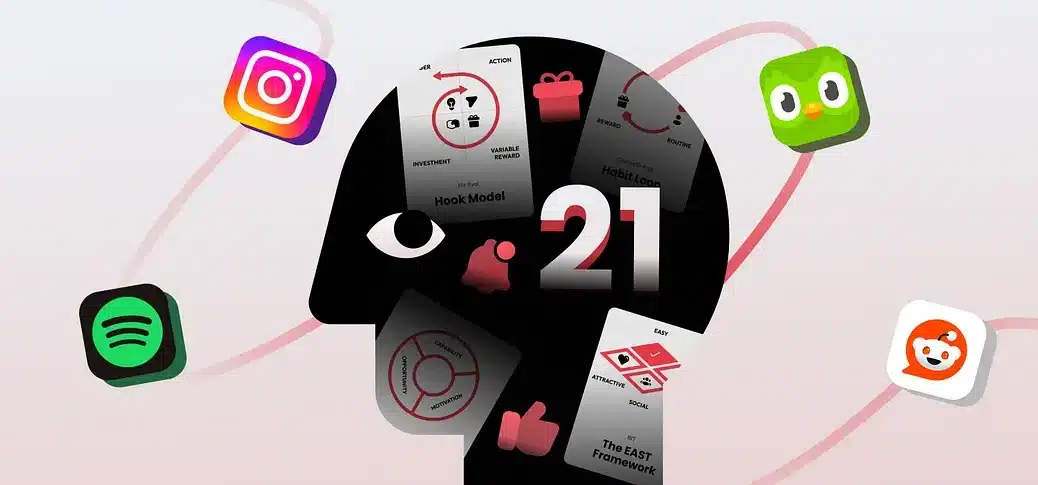
21 UX strategies to maximize user engagement without exploitation.
Behavioral design frameworks
Here are some of the most popular and influential behavioral design and habit-formation models:
- O Hook Model , developed by Nir Eyal It consists of four stages: Trigger, Action, Variable Reward, and Investment. It explains how to build habit loops by leveraging rewards and user investment.
- The Habit Loop, of Charles Duhigg Habits are formed through cycles of cue, routine, and reward.
- Structure EAST from the Behavioural Insights team : Make behaviors easy, appealing, social, and timely to increase engagement.
- COM-B Model from the Professor Susan Michie and his team at UCL: Behavior depends on Ability, Opportunity, and Motivation.
- BJ Fogg's Behavioral Model (FBM) : The behavior occurs when motivation , the ability e the triggers They align. Simpler actions and well-timed triggers increase engagement.
- The Nudge Theory by Richard H Thaler and Cass R Sunstein: Small and subtle changes In design, they can guide user behavior without limiting choices.

Finding patterns and similarities
Upon examining these models, it becomes evident that they share key components related to user behavior, motivation, and habit reinforcement. By identifying these similarities, I developed a unified formula.

O Sustainable Engagement Loop It is a behavioral model designed to promote long-term user engagement through a cyclical process that builds and maintains habits. This model revolves around six main stages:
- Triggers External or internal signals lead users to take action.
- Motivation Users need sufficient motivation to respond to the trigger.
- Action The desired behavior or action is performed.
- Reward A significant or variable reward reinforces the action, encouraging repetition.
- Investment Users invest time, effort, or resources, increasing their commitment.
- Progression Users experience growth and advancement, which promotes continuous engagement.
The model also considers Relapse & Reinstatement , addressing moments when users disconnect. Through well-timed triggers and reminders, users are encouraged to return to the loop, re-establishing the habit.
Creating effective triggers
A well-designed trigger is the foundation of any successful engagement cycle, making the crucial difference between users taking action or losing interest.

- External triggers , Notifications, reminders, and visual cues encourage users to take action, especially in the early stages of habit formation, while internal triggers , Emotions such as boredom, anxiety, or excitement lead users to engage with the product without needing external cues.
- Proactive triggers are initiated by the system without any prior user interaction, while reactive triggers These are responses to user behavior, designed to encourage greater engagement based on their previous actions.
- Contextual triggers They are based on the user's current situation, such as location or activity, requesting actions relevant to their environment, while programmed triggers They occur at predefined times, encouraging users to engage based on a specific time period or routine.
- Custom triggers They are adapted to the individual preferences, habits, or behaviors of the user, while generic triggers These are broad and universal warnings that are sent to all users, regardless of their specific context or needs.
✅ 1. Ensure punctuality and balance the firing frequency.
Triggers should appear precisely when users are most likely to act, as excessive or poorly timed triggers can cause frustration, notification fatigue, and disinterest, making it crucial to find the right balance to retain users.
(For example, the Duolingo home screen widget stays on the user's home screen, providing a constant, yet non-intrusive, reminder to continue their language learning sequence.)
✅ 2. Prioritize personalized and value-based triggers.
Customized triggers are significantly more effective than generic ones because they cater to the user's specific needs, preferences, and habits. Triggers should always provide value, and it's essential to avoid sending trivial or unnecessary notifications that could lead to user disengagement.
(e.g., Starbucks notifications are tailored to individual purchase history and preferences, offering personalized deals or timely reminders.)
✅ 3. Take advantage of internal triggers over time.
The goal of external triggers is, eventually, to help users develop internal triggers, where emotional or psychological cues (e.g., boredom, anxiety) drive engagement without needing a push from the system.
(for example, over time, Instagram conditions users to check the app regularly, motivated by internal triggers such as boredom, curiosity, or fear of missing out (FOMO))
Motivating users to engage
In behavioral design, motivation e ability These are essential elements to ensure that the triggers lead to action.

- Two types of motivation drive user engagement. Intrinsic motivation It comes from personal satisfaction or pleasure, while extrinsic motivation It involves external rewards, such as points or reminders.
- User capabilities can be classified into several types, including cognitive ability (mental effort), physical capacity (ease of interaction), time availability (how much time do users have), financial capacity (cost of the action), effort and skill (knowledge or effort required), etc.
✅ 4. Highlight the reward ( Cost-benefit )
Ensure that users perceive the benefits of completing an action as significantly greater than the effort required. This increases the likelihood that they will take the desired action.
(e.g. Nudge to get 3 free shares valued at over US$$ 75 after completing a trial on the Bloom app)
✅ 5. Encourage users to make small initial commitments.
Encourage users to do small, low-effort commitments at the beginning of their journey. This helps build responsibility and intrinsic motivation.
(e.g., Duolingo asks users to commit to a learning sequence and provides choices that give users a sense of autonomy)
✅ 6. Balance intrinsic and extrinsic motivation
Combine external rewards like points or badges with intrinsic motivators, such as personal satisfaction or skill development. While extrinsic motivation can drive short-term engagement, intrinsic motivation fosters long-term commitment and loyalty.
(e.g., Nike Run Club members earn extrinsic rewards like trophies and badges for completing races, while the sense of personal accomplishment and progress as their fitness improves provides intrinsic motivation.)
Effortless and almost instinctive actions
Action is the central outcome of each carefully designed element. It's not just about what users do; it's about how easily they can execute that behavior.

✅ 7. Design for single-task focus
The most successful products generally guide users to focus on one main action at a time. By reducing distractions and presenting a single, clear task, users are more likely to follow through with an action.
(e.g., Amazon's "Buy Now" button simplifies the purchasing process by allowing users to instantly complete their transaction with a single click)
✅ 8. Provide instant feedback
Reinforce user behavior with immediate feedback, such as success messages, animations, or progress updates. This assures users that their actions are recognized.
(e.g., Tinder's single-task-centric swiping interface provides instant feedback with each swipe. Additionally, the use of variable rewards keeps engagement high, as users don't know when they will receive a match.)
✅ 9. Encourage frequent repetition of routine actions.
Repeating actions frequently helps to imprint them in users' minds, transforming behaviors into almost automatic routines. By designing actions that can be easily repeated, you create habits that make user engagement seem natural and continuous over time.
(e.g., TikTok encourages frequent repetition through its infinite scrolling feed , where users repeatedly swipe up to view new content. This simplicity, combined with instant feedback e variable rewards (Since users never know what video will come next, this makes the behavior almost automatic and highly engaging over time.)
Reinforce user actions with rewards.
Rewards encourage users to continue interacting with a product by providing immediate gratification or a sense of accomplishment.

- Behavioral conditioning — a concept used in both psychology and animal training, explains how behaviors can be shaped and reinforced through rewards (positive reinforcement).
- Fixed rewards They provide predictable and consistent reinforcement after a specific action, while variable rewards They introduce an element of surprise, activating the brain's dopamine system to create greater engagement and anticipation.
- The three types of rewards are hunting rewards , which satisfy the desire for resources or information, personal rewards , who achieve mastery or personal accomplishment, and tribe rewards , which provide connection or validation of others.
✅ 10. Harness the power of unpredictability
Offer unpredictable rewards to keep users coming back, as the uncertainty of the outcome creates excitement and anticipation.
(e.g., games like Fortnite or Overwatch use loot boxes that offer random rewards. Players don't know what items they'll receive when they buy or win a loot box, which keeps them excited and coming back for more.)
✅ 11. Gamify the experience with points and badges.
Gamify user experiences by offering points, badges, or trophies that users can earn through repeated actions. This satisfies the desire for features.
(e.g. Reddit uses badges and awards that users can earn or give to others for valuable contributions. These badges not only encourage frequent participation but also create social validation, making the experience more engaging.)
✅ 12. Create social rewards through competition or recognition.
Reinforce user behavior with immediate feedback, such as success messages, animations, or progress updates. This assures users that their actions are recognized.
(e.g. TikTok excels at this by providing real-time feedback in the form of likes, comments, and ratings on popular content. Users receive instant recognition through likes and comments, and their engagement is further boosted by the competitive element.)
The investment makes users less likely to abandon the product.
Driven by psychological mechanisms such as sunk cost fallacy. The more time, effort, or resources users invest in a product or platform, the more committed they become.

- Investment in time and effort . Time is a valuable resource, and when users spend significant time learning about or engaging with a product, they become more attached to it.
- Users who do investments in data or content , Activities like sending photos, sharing videos, or recording fitness data develop a sense of ownership over their creations.
- Social investment, This occurs when users build relationships, followers, communities, or social validation within a platform.
- When users spend money on a product or service, they feel a greater commitment to using it, motivated by the desire to get value from it. financial investment .
✅ 13. Encourage small initial investments and content contributions.
Encourage users to take small, easy-to-complete actions early in their interaction, such as filling out a profile or selecting preferences. Encourage users to contribute content, whether by uploading videos, writing reviews, or posting photos.
(e.g., Instagram encourages small initial investments by requiring users to create profiles and follow accounts. It also boosts initial engagement through easy content sharing, and over time, the social investment in building a network of followers makes it harder to switch to other platforms.) . )
✅ 14. Enable personalization and customization
Allow users to personalize their experience, such as creating playlists, setting preferences, or organizing content.
(For example, Spotify allows users to personalize their experience by creating custom playlists, setting preferences, and organizing their music library based on their favorite artists or genres).
✅ 15. Create opportunities for long-term investment.
Help users engage in long-term investments, such as building something over time (e.g., leveling up characters, unlocking achievements). A tiered reward system where users gain access to better rewards or features the longer they engage.
(For example, Booking.com uses a tiered loyalty program, Genius, where users unlock better discounts and benefits the more they book and engage with the platform.)
Give users a sense of growth and accomplishment.
Progression It is the continuous improvement a user experiences when interacting with a product, and frames These are important achievements that mark this progress. Unlike short-term rewards, which offer immediate gratification, progression and milestones provide long-term satisfaction, driving continued engagement.

✅ 16. Display a visible progression path.
Create a clear and visible roadmap, helping users visualize their journey and motivating them to reach the next stage.
(for example, Duolingo It displays a language learning path with clear milestones that users aim to achieve, giving them a sense of accomplishment and clarity about what comes next.
✅ 17. Offer milestones at different levels and celebrate them.
Implement tiered milestones that provide increasingly valuable rewards or recognition as users progress. Celebrate important milestones in a user's journey by providing positive reinforcement when users achieve significant accomplishments.
(ex.: The Ladder It rewards users with tiered milestones, such as completing exercises, and badges that create a personal wall of achievements. This visual display of progress, combined with celebratory messages, keeps users motivated.
✅ 18. Incorporate dynamic difficulty ramps
Gradually increase the difficulty of tasks or challenges as users progress. This keeps users engaged. flow state where the tasks seem achievable, but challenging enough to remain interesting.
(ex.: Headspace It gradually introduces more advanced meditation techniques and longer session durations as users become more comfortable with the basics.
Ethical considerations for designing addictive products.
Many of the strategies shared here leverage psychological behaviors that are often outside the conscious control of users, making certain products highly addictive. While some of these engagement cycles lead to positive outcomes (such as learning a new skill or improving fitness), others can have negative consequences, leading to compulsive, unproductive, or harmful behaviors, such as... Doomscrolling . This places a significant ethical responsibility on design teams to ensure they use these tactics responsibly, balancing engagement with the well-being of their users.
✅ 19. Avoid doomscrolling and limit the abuse of variable rewards.
Limit infinite scrolling and avoid excessive use. variable rewards , Unpredictable likes or comments can lead to compulsive behavior, such as those related to new content. These design patterns, often used to increase engagement, can result in compulsive behavior by constantly serving new content. Incorporate features that encourage users to take breaks.
(For example, Instagram helps prevent scrolling doom by incorporating the "You're All Caught Up" feature, which notifies users when they've seen all the recent posts from the accounts they follow.)
✅ 20. Mitigate social validation traps
To avoid fostering unhealthy competition and social comparison, platforms should reduce the emphasis on likes, shares, and comments as primary indicators of success. By designing experiences that prioritize... By prioritizing meaningful engagement over quantitative metrics, platforms can encourage healthier interactions.
(e.g., BeReal limits social comparison by allowing users to post only once a day within a two-minute window.)
✅ 21. Provide transparency and algorithm control
Be transparent about algorithms and recommendation systems, while also providing clear insights into the time spent on the platform. This allows users to manage their content and engagement more consciously, promoting healthier interactions.
(e.g., YouTube allows users to see why certain videos are recommended and adjust their preferences. They can disable specific recommendations, clear their viewing history, and use insights.) of "Assisted Time"“ (to monitor daily and weekly usage, promoting healthier viewing habits.)


